Compact Fiber Unit vs. Traditional Equipment
Advanced FTTH Optical Cable Manufacturing Line Machinery Platforms
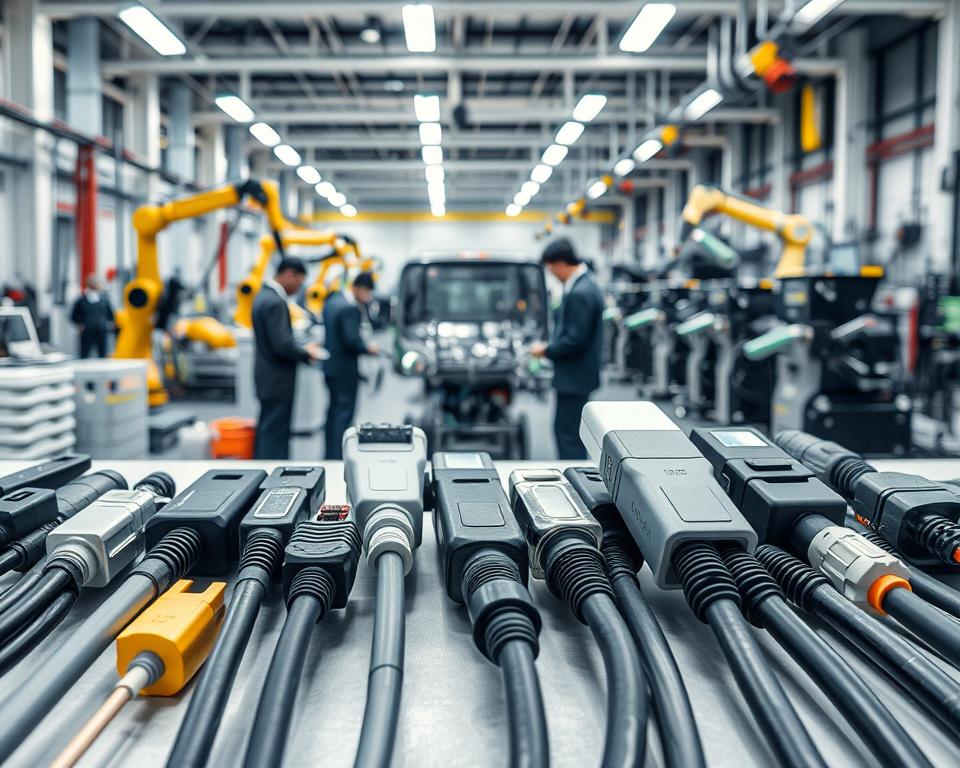
Did you ever consider the impact of soaring internet cable demand on FTTH cable production technology? As our need for fast, reliable connectivity escalating, industry leaders like HONG KAI and Nextrom are reshaping production. They’re rolling out cutting-edge cable equipment to enhance production efficiency. This shift not only reduce operational costs but also enhances high-speed internet cable quality, meeting today’s market standards.
Here, we’ll examine the groundbreaking equipment and methods reshaping fiber secondary coating line manufacturing. Discover how these innovations are ready to transform the fiber optic sector.
Important Lessons
- Understanding the importance of FTTH cable production line equipment in high-speed internet access.
- Exploring the significant role of companies like HONG KAI and Nextrom in driving technology innovation.
- Discovering the benefits of adopting next-gen cable equipment in manufacturing processes.
- Recognizing how improved cable quality is critical for meeting consumer demands.
- Appreciating the importance of production efficiency in a competitive market.
Understanding FTTH Cable Production Line Technology
The creation of fiber optic cables, mainly for FTTH technology, involves a complex blend of advanced tools and exact methods. Modern production of these cables includes various components that boost efficiency and quality. Knowing these parts sheds light on the progress toward more advanced production systems.
Core Components of Contemporary Fiber Optic Cable Manufacturing
Today’s fiber optic cable making includes:
- Extruder systems for coating and insulating fibers
- Fiber tension control mechanisms to preserve optimal fiber quality
- Automated operations that simplify production processes
These components work together to create a reliable and long-lasting product. For instance, advanced temperature control systems ensure consistent conditions. Automated adjustments also reduce human error.
Evolution from Traditional to Modern Production Systems
The shift from traditional to advanced systems represents a significant leap in technology and methods. Earlier, manual methods have been superseded by automated systems. This change has resulted in:
- Higher productivity and reduced production times
- Reduced waste due to accurate material handling
- Improved product quality thanks to stricter quality control
Key Technologies Driving Industry Innovation
Several key technologies are driving innovation in the fiber optic field. These include:
- Precision temperature control that regulates and maintains optimal production conditions
- Automatic settings that adapt to changing production requirements
- Advanced monitoring systems offering real-time feedback on production quality
Thanks to these technologies, manufacturers can guarantee their fiber optic products meet the stringent standards required for FTTH applications.
Essential Equipment for Fiber Secondary Coating Line Operations
In the world of fiber optic cable manufacturing, the fiber secondary coating line is crucial. It protects fiber optics through efficient coating processes. With technology evolving, equipping with the latest equipment is critical for improved production and reliability.
High-Speed Secondary Coating Processes
Advances in secondary coating processes have dramatically boosted manufacturing efficiency. Modern systems can now handle increased volumes, meeting rising demand. These processes apply coatings that enhance durability and performance, resulting in superior fiber cable products.
Single and Dual Layer Coating Applications
It’s important to know between single and dual layer coatings in the fiber secondary coating line. Single-layer coatings provide basic protection, while dual-layer coatings add extra resistance to environmental stressors. Both methods use high-speed processes for uniform coating application, guaranteeing fiber optics perform longer in various conditions.
Temperature Control and Curing Systems
Temperature control systems are vital for curing coatings during production. They maintain the right conditions for adhesive substances in the fiber secondary coating line. Proper temperature management allows for perfect curing times and conditions, resulting in higher quality fibers ready for real-world use.
Fiber Draw Tower and Optical Preform Processing
The fiber draw tower is crucial in optical preform processing and cable manufacturing. It pulls the preform into thin fiber strands, guaranteeing high-quality fibers with excellent clarity and strength. The tower’s ambiance is carefully controlled to achieve precise dimensions and physical properties.
Optical preforms serve as the foundation of this process, defining the fiber’s final characteristics. The preform’s quality affects light transmission and durability. Advances in preform manufacturing have improved Fibers in metal tube manufacturing efficiency.
Through innovative engineering and technology, the fiber draw tower and preform processing constantly evolve, addressing the growing demand for high-performance fiber optic cables. Quality at the preform level yields better fiber optics, enhancing telecommunications and networking services.
Advanced SZ Stranding Line Technology for Cable Assembly
The SZ stranding line technology marks a major advancement in cable assembly, especially for fiber optic cables. It ensures precise stranding, critical for crafting top-tier cables that adhere to strict standards.
Precision Stranding Equipment Features
The core of the SZ stranding line is its precision stranding equipment, which enhances cable durability and reliability. Its notable attributes include:
- Advanced control systems that tweak settings in real-time for peak performance.
- High-speed operation that improves production efficiency.
- Modular design for customization based on production needs.
Automated Tension Control Systems
Automated tension control systems are critical for maintaining consistency in stranding. They:
- Ensure uniform fiber tension and strength distribution along the cable.
- Lower defect rates, reducing waste and production costs.
- Enable seamless integration of diverse materials, improving flexibility and performance.
Integration with Fiber Cable Sheathing Line
The integration of the SZ stranding line with the fiber cable sheathing line enhances production efficiency. This synergy enables for:
- Efficient workflows by reducing manual intervention.
- Consistent quality throughout the manufacturing process.
- Higher throughput, addressing the growing need for superior cables.
Fiber Coloring Machine and Identification Systems
The fiber coloring machine is vital in telecom fiber cable production. It guarantees each cable is identifiable and meets color coding standards. Modern technology enables quick and precise color application, boosting manufacturing efficiency.
High-Speed Coloring Technology
State-of-the-art machines use high-speed technology for uniform and fast color application. This reduces production time without compromising quality. The machines’ precision secures accurate color application, helping adherence to strict color coding standards, crucial for smooth installation and maintenance.
Color Coding Standards for Telecom Fiber Cables
Color coding standards guide manufacturers and technicians in the telecom industry. They systematize fibers for easy identification, minimizing installation and troubleshooting errors. Each color represents a specific function or fiber type, ensuring clarity in complex networks.
Following these standards, enabled by fiber coloring machines, improves safety and efficiency—a pillar of telecom operations.
Quality Control in Fiber Identification
Quality control is paramount in fiber identification systems to meet market standards. Regular inspections during production check color accuracy and coding adherence. Advanced traceability systems trace fibers, improving product reliability.
This methodical quality control approach yields superior telecom fiber cable performance, delighting both manufacturers and end users.
Specialized Solutions for Fibers in Metal Tube Production
The production of fibers in metal tubes is a key domain in modern cable solutions. This method boosts durability and environmental resistance of optical cables, making them ideal for harsh conditions. Specialized techniques envelop fibers in metal, shielding them from damage and extreme environments.
In outdoor settings, where cables face tough elements, these solutions demonstrate their worth. Manufacturers have engineered advanced methods to fortify and boost cable reliability, addressing the growing demand for durable communication systems. Precision SZ stranding line engineering and premium materials are essential in this process.
Employing specialized manufacturing methods guarantees cables remain intact and functional across industries. Companies focus on innovative designs and strong materials to create high-performance optical cables for diverse environments and applications.
Fiber Ribbon Line and Compact Fiber Unit Manufacturing
The manufacture of fiber ribbons and compact fiber units is vital for modern telecommunication networks. This section highlights the latest equipment and designs for these essential components. Innovators aim to meet the rising demand for high-density cable solutions in data centers.
Advanced Fiber Ribbon Line Equipment
Cutting-edge fiber ribbon line equipment enables efficient production of high-quality optical fibers. It integrates the latest technology to produce compact fiber units with top performance, minimizing waste and boosting throughput to suit various needs.
Compact Fiber Unit Design and Production
Compact fiber units are designed for space efficiency without sacrificing performance. Innovative methods shape these units for straightforward installation in diverse settings. These units are key for data centers, addressing the need for dense cables that save space and accelerate data transfer.
High-Density Cable Solutions for Data Centers
High-density cable solutions are critical for modern data centers, enabling faster data transfer and greater bandwidth. These solutions often incorporate fiber ribbons, produced through advanced processes. As data usage surges, these cables underpin robust infrastructure to meet today’s digital demands.
Optimizing High-Speed Internet Cables Production
Efficient production of high-speed internet cables is fundamental for today’s networks. The quality of FTTH cabling systems drives reliable connections. Advanced manufacturing aims to boost performance while maintaining high standards.
Cabling Systems for FTTH Applications
FTTH cabling systems feature designs that improve signal transmission and cable longevity. They utilize premium materials and cutting-edge engineering to deliver fast, dependable internet for users.
Quality Assurance in Fiber Pulling Process
The fiber pulling process is critical in cable production, requiring precise attention. Quality checks avoid damage and maintain signal integrity. Integrated monitoring systems guarantee cable reliability and facilitate seamless installation.
Meeting Industry Standards for Optical Fiber Drawing
Adhering to industry standards in optical fiber drawing is vital for manufacturers. It guarantees production safety and cable reliability. Improving techniques and materials helps meet these standards, yielding superior cabling systems.
Final Thoughts
The evolution of FTTH cable production lines has revolutionized telecommunications, enabling manufacturers to produce high-quality, reliable cables for today’s internet demands. As technology advances, adopting advanced manufacturing solutions is paramount to improve production efficiency while upholding top standards.
With the rising need for robust infrastructure, companies must adopt innovative methods in their FTTH cable production. These advanced approaches improve cable reliability and promote sustainable manufacturing in the fiber optic sector.
To stay competitive in the fiber optic cable industry, embracing these advanced solutions is critical. The future of cable production hinges on such innovations, ensuring telecommunications infrastructure can meet the growing global internet demands.